

In today's workplace, drug testing policies are becoming increasingly common. While most people associate drug tests with illegal substances, many employees wonder: can employers test for prescription drugs too? The answer is more nuanced than a simple yes or no. Understanding how prescription medications fit into workplace drug testing policies is essential for protecting both your job and your health.
In this blog, we break down how prescription drug testing works, your rights as an employee, and what to expect if you are taking medication including a critical 2025 legal update that every employer and employee needs to know.
What Is Prescription Drug Use?
Prescription drugs are medications legally prescribed by a licensed healthcare provider to treat medical conditions. These include:
- Pain relievers — opioids like oxycodone and hydrocodone
- Anti-anxiety medications — benzodiazepines like Xanax and Valium
- ADHD medications — stimulants like Adderall and Ritalin
- Sleep aids and sedatives
Even though these medications are legal, they can still appear in drug tests because many fall under controlled substances categories screened by standard workplace panels. Learn about what causes false positive drug test results including common prescription medications.
Can Employers Test for Prescription Drugs?
Yes employers can test for substances that include prescription medications. However, the key distinction lies in how results are interpreted, not whether the substances are detected.
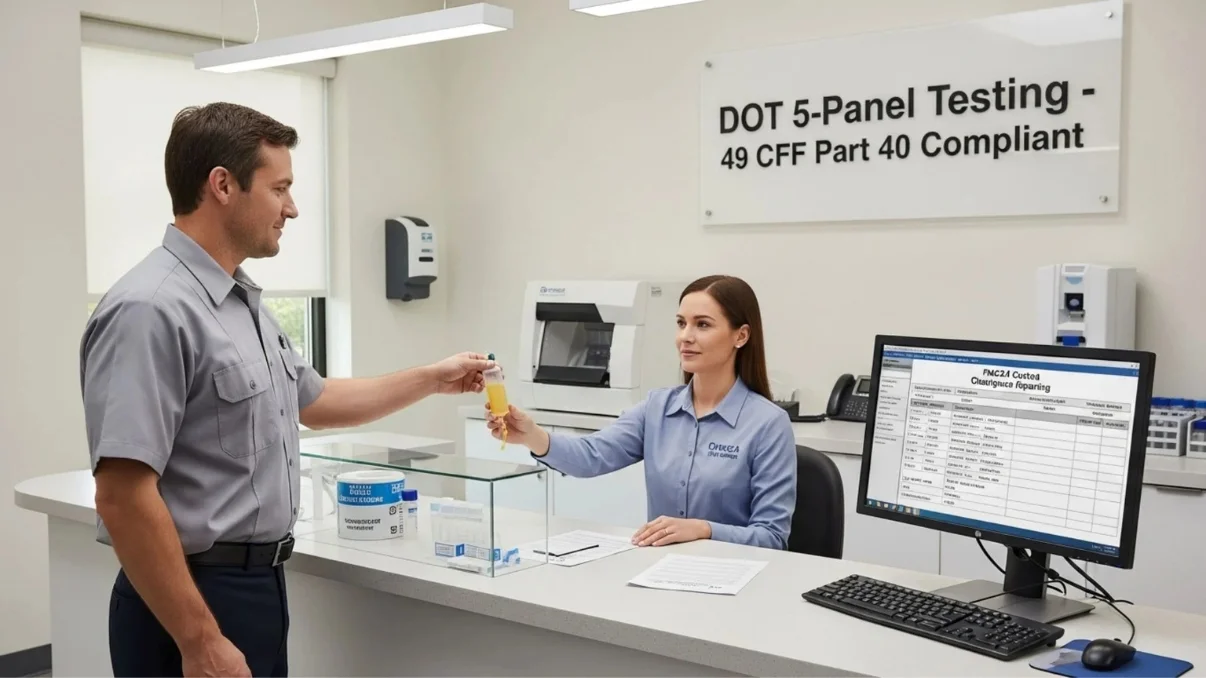
Most workplace drug testing programs including the standard DOT 5-panel urine drug test are designed to detect five major substance categories:
- Opioids
- Amphetamines
- Marijuana
- Cocaine
- PCP
If you are taking a prescribed medication in one of these categories, it may trigger a non-negative result. But that does not automatically mean you will face consequences this is where the Medical Review Officer (MRO) process becomes critical.
Important ADA note for employers: Employers should not ask employees or applicants about their prescription drug use as part of the pre-hiring or pre-promotion drug testing process. Some state courts have ruled that requesting such information constitutes discrimination and violates the ADA and alleged ADA violations account for nearly half of all lawsuits involving drug-free workplace programs.
How Prescription Drug Testing Works
When a drug test is conducted, the lab first identifies whether any substances are present above the cutoff threshold. If a result comes back non-negative, it is reviewed by a Medical Review Officer (MRO) a licensed physician specifically trained to evaluate workplace drug test results.
The MRO will:
- Contact you directly to ask about any prescriptions
- Request proof of your medication such as a doctor's note or prescription label
- Verify whether the drug use is legitimate and consistent with the prescription
If your prescription is valid and used as directed, the result is typically reported as negative to your employer. The employer never learns why only that the result was negative. This process protects employee privacy while ensuring test integrity. Understand the full chain of custody process and how MRO review fits within it.
2025 Legal Update: EEOC Victory on Prescription Drug Testing
A May 2025 jury verdict has significant implications for how employers must handle prescription drug-related test results. In EEOC v. The Princess Martha, LLC, a jury awarded more than $400,000 in damages to a job applicant a veteran who was denied employment after failing a drug test. The applicant had informed the employer she might fail because of legally prescribed medications she took for PTSD.
The EEOC successfully argued that the employer violated the ADA by failing to allow the applicant to explain her non-negative drug test result before withdrawing the job offer. The verdict reinforces that employers cannot take adverse action based solely on a non-negative drug test result when the applicant has disclosed or indicated that a legal prescription may be responsible. The MRO verification process and allowing it to complete fully before making any employment decision is not just best practice. It is a legal requirement.
When Can Employers Require Drug Testing?
Employers can require drug testing in several situations. In all cases, prescription drugs may be detected, but employers must follow legal guidelines including completing MRO review before taking any action:
- Pre-employment screening — after a conditional job offer is made
- Random drug testing — unannounced, using scientifically valid selection. Learn how frequently random drug testing is required
- Post-accident testing — after qualifying workplace incidents
- Reasonable suspicion testing — based on documented supervisor observations
Employee Rights and Legal Protections
Employees who use prescription medication have important legal protections under federal law:
- Americans with Disabilities Act (ADA) — prohibits employers from discriminating against employees based on a disability. If a prescription medication is being used to treat a qualifying disability, the employer may have accommodation obligations. The ADA also prohibits employers from asking about prescription drugs before making a conditional job offer
- Medical privacy — all drug test results and any prescription information disclosed to the MRO must be kept confidential. Employers receive only the final negative or positive result — not the underlying medical details
- Right to dispute — employees can dispute a non-negative result, particularly if a prescribed medication may have caused it. Request that the MRO conduct additional confirmatory GC-MS testing to rule out false positives
- Right to split-specimen retest — employees have the right to request testing of the split specimen at a different certified laboratory within 72 hours of MRO notification
Important consideration: if a medication affects your ability to perform your job safely particularly in safety-sensitive positions your employer may take action even with a valid prescription. The medication's effect on job performance matters, not just its legal status.
What Happens If You Test Positive?
Testing positive for a prescription drug can lead to different outcomes:
1. Valid Prescription
If you provide proof to the MRO and the prescription is verified as legitimate and used as directed, the test is reported as negative to your employer. No further action results.
2. No Prescription or Unable to Verify
If you cannot produce a valid prescription for a detected controlled substance, the MRO will confirm the result as positive. This is treated as a failed drug test with the same consequences as any other positive result.
3. Safety-Sensitive Jobs
In roles like CDL driving or operating heavy machinery, even a verified and legitimately prescribed medication may raise safety concerns. The MRO and the employee's prescribing physician determine whether the medication disqualifies the employee from performing safety-sensitive functions. This is separate from whether the result is reported as positive or negative it is a fitness-for-duty determination. See what happens when you fail a DOT drug test and what the full consequences involve.
2026 Update: Marijuana Rescheduling and Prescription ADA Implications
On December 18, 2025, President Trump signed an Executive Order directing the DOJ to complete rescheduling of marijuana from Schedule I to Schedule III. If finalized, this could create a new ADA dynamic: employees with a qualifying disability may be able to seek reasonable accommodation for medical marijuana use, since Schedule III drugs are recognized as having accepted medical use.
However, for DOT-regulated employees, nothing changes until rescheduling is legally finalized and even then, DOT drug testing rules under 49 CFR Part 40 would need to be separately amended. The DOT issued a formal compliance notice on December 19, 2025 confirming testing remains unchanged. Learn more about why marijuana legalization does not protect CDL drivers under current federal rules.
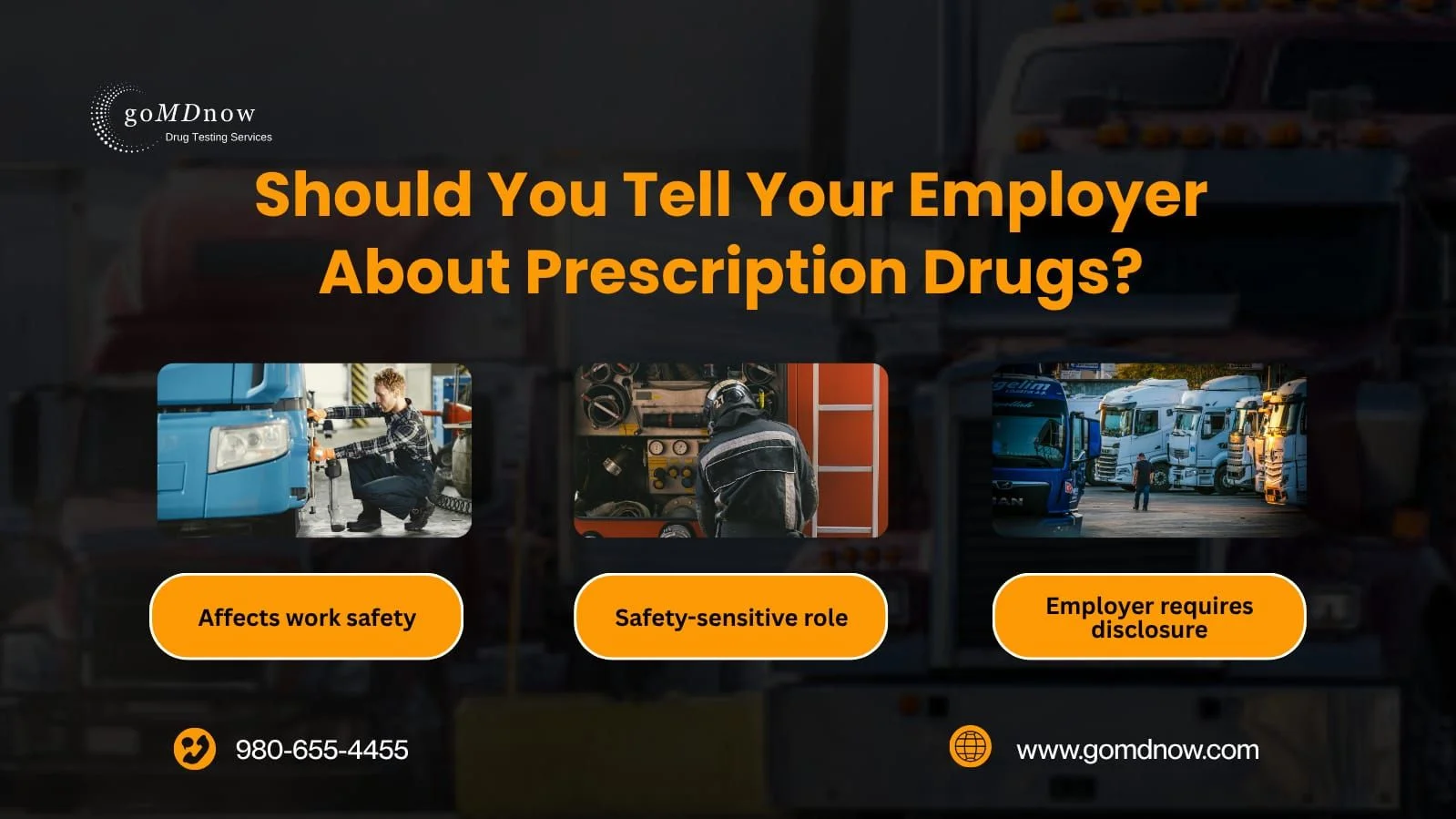
Should You Tell Your Employer About Prescription Drugs?
Generally, you do not need to disclose your medication to your employer only to the MRO if you test non-negative. You are not required to share personal medical information upfront unless:
- The medication affects your ability to work safely
- You are in a regulated or safety-sensitive role
- Your employer specifically requires disclosure by policy
It is generally better to wait until a drug test requires MRO verification rather than volunteering personal medical details in advance. However, if you know your medication may trigger a non-negative result, informing the testing collection site not your employer is a practical step.
How to Prepare for a Workplace Drug Test
- Keep your prescription documentation ready — a bottle label or doctor's note
- Inform the testing authority (not your employer) if you anticipate a non-negative result
- Follow your dosage exactly as prescribed — overuse can raise red flags even with a valid prescription
- Avoid sharing medications with others — using someone else's prescription is both illegal and a test failure
- Know your right to request GC-MS confirmatory testing and a split-specimen retest if you believe a result is incorrect
Risks of Misusing Prescription Drugs
Even though prescription drugs are legal, misuse can lead to serious consequences:
- Failed drug tests and workplace disciplinary action
- Health complications and increased risk of dependency or addiction
- Loss of CDL or professional license for safety-sensitive employees
- Clearinghouse reporting for DOT violations learn about Clearinghouse violations and long-term consequences
Always use medications exactly as prescribed to avoid both health and professional risks.
Common Mistakes to Avoid During Prescription Drug Testing
- Not carrying prescription proof — always keep documentation ready in case MRO verification is needed
- Self-medicating or sharing drugs — using someone else's prescription leads to a failed test with no valid defense
- Overusing medication — taking higher doses than prescribed can produce results that raise additional scrutiny
- Hiding information from the MRO — transparency during MRO review is essential and protected by confidentiality
- Assuming a non-negative is a positive — it is not. The MRO process exists specifically to evaluate whether a legitimate prescription explains the result
Prescription Drugs vs. Illegal Drugs in Testing
| Factor | Prescription Drugs | Illegal Drugs |
|---|---|---|
| Legality | Legal with valid prescription | Illegal |
| Drug Test Result | Can be cleared through MRO verification | Typically confirmed as positive |
| Employer Action | Depends on MRO verification outcome | Usually strict immediate action |
| ADA Protection | May apply if disability-related | Does not apply to current illegal use |
FAQs
1. Can a drug test detect prescription medication?
Yes, especially if the medication contains controlled substances such as opioids, amphetamines, or benzodiazepines. These appear on standard panels regardless of prescription status.
2. Will I fail a drug test if I have a prescription?
Not usually. If you provide valid proof to the MRO, the result can be verified as negative. The 2025 EEOC case also confirmed that employers must allow you the opportunity to explain before taking any adverse action.
3. Do I need to tell my employer about my medication?
Generally no only if it affects your job performance or safety. Disclose to the MRO if you test non-negative, not to your employer directly.
4. What happens if I don't have proof of prescription?
If you cannot verify the medication with the MRO, it may be treated as a confirmed positive drug test with the same consequences as any other positive result.
5. Can an employer ask about my prescriptions before I take a drug test?
Generally no. Under the ADA, employers should not ask about prescription drug use as part of the pre-hiring or pre-promotion process. Doing so could constitute disability discrimination and has led to successful lawsuits.
Final Thoughts
Prescription drug use and workplace drug testing is a nuanced area with real legal consequences on both sides. The MRO process exists to protect employees from wrongful consequences for legitimate medication use but only when it is allowed to run its full course. The 2025 EEOC verdict makes clear that employers who short-circuit that process face significant legal exposure.
For employees: know your rights, keep your documentation, and disclose to the MRO not your employer. For employers: let the MRO process complete before taking any action on a non-negative result, and never ask about prescription drug use before a conditional offer is made.
goMDnow provides nationwide drug testing with qualified MRO review on every non-negative result ensuring your program protects both workforce safety and employee rights. Explore our nationwide testing network, review our drug testing pricing, or contact us to build a program that holds up legally in 2026.