

Commercial truck drivers play a critical role in keeping goods moving across the United States. Because commercial motor vehicles can pose significant safety risks when operated improperly, the U.S. Department of Transportation (DOT) has established strict requirements for drivers and motor carriers.
DOT requirements cover areas such as commercial driver's licenses, medical certification, drug and alcohol testing, hours of service, vehicle inspections, recordkeeping, and safety compliance. Understanding these requirements helps drivers avoid violations, protect their CDL, and maintain compliance with federal regulations.
For drivers subject to Federal Motor Carrier Safety Administration (FMCSA) regulations, compliance is not a one-time responsibility. Requirements must be followed throughout their commercial driving careers.
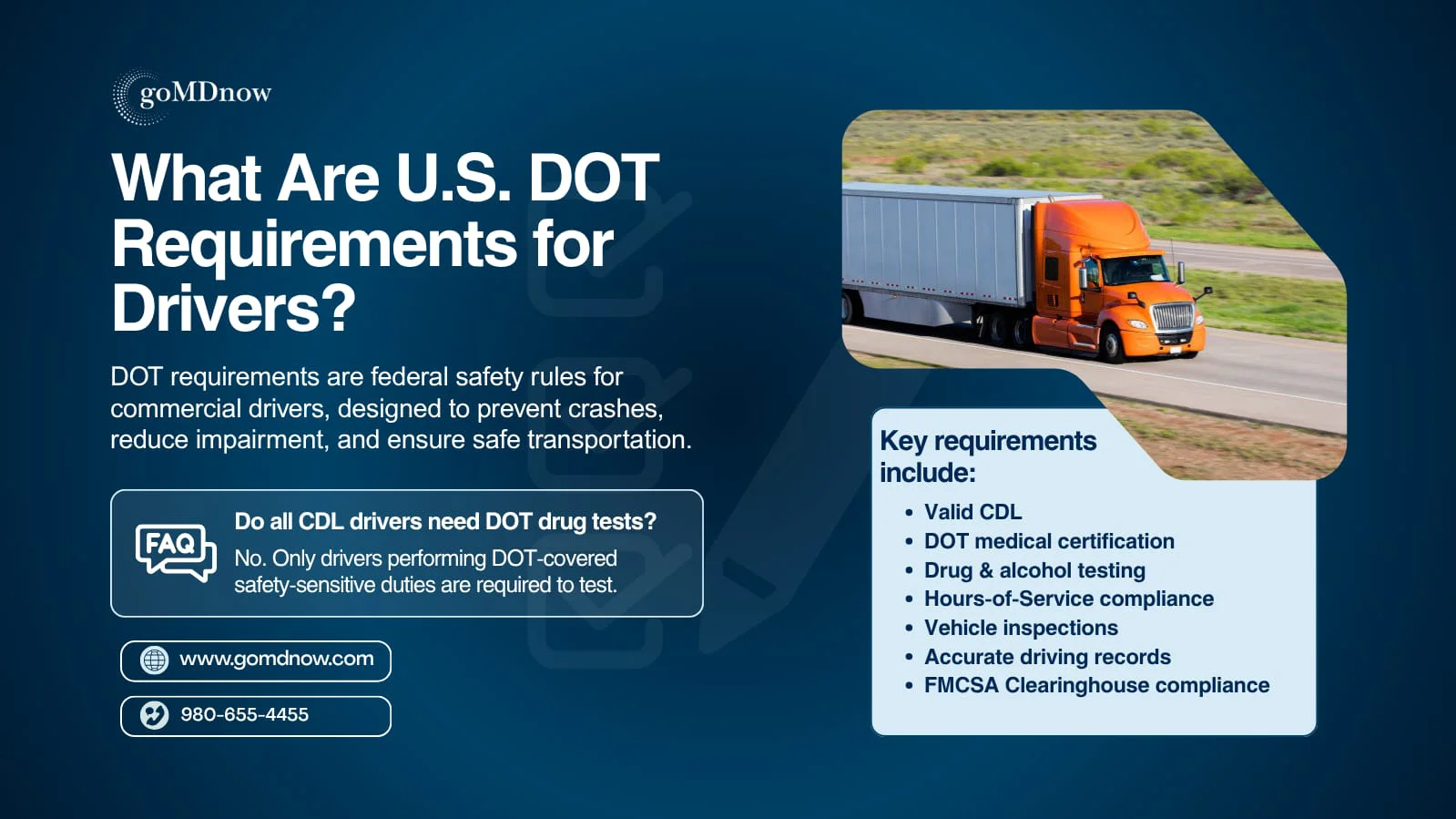
What Are U.S. DOT Requirements for Drivers?
DOT requirements are federal rules that apply to commercial drivers and motor carriers operating in interstate commerce when they fall under DOT jurisdiction. These requirements are primarily administered through the Federal Motor Carrier Safety Administration (FMCSA).
The purpose of these regulations is to reduce crashes, prevent driver impairment, ensure drivers are medically qualified, and promote safe commercial transportation. Drivers can review the broader consequences in our guide to DOT violations and compliance failures.
Depending on the type of commercial driving a person performs, requirements may include:
- Having a valid commercial driver's license (CDL)
- Meeting minimum age requirements
- Passing a DOT medical examination
- Completing required drug and alcohol testing
- Following hours-of-service regulations
- Maintaining accurate driving and duty records
- Completing required vehicle inspections
- Following controlled-substance and alcohol regulations
- Participating in required random testing programs
- Complying with FMCSA Clearinghouse requirements
Not every requirement applies identically to every driver. Requirements can depend on the vehicle, type of operation, cargo, route, and whether the driver operates under federal or state regulations.
1. Commercial Driver's License Requirements
One of the most important DOT requirements is having the appropriate Commercial Driver's License (CDL). Drivers generally need a CDL when operating certain types of commercial motor vehicles. The CDL class and endorsements required depend on the vehicle and the type of transportation involved.
Class A CDL: Generally required for combination vehicles with a gross combination weight rating (GCWR) of 26,001 pounds or more when the vehicle being towed exceeds 10,000 pounds.
Class B CDL: Generally applies to single vehicles with a gross vehicle weight rating (GVWR) of 26,001 pounds or more, or certain combinations that meet the applicable requirements.
Class C CDL: May apply to vehicles that do not meet Class A or B definitions but are designed to transport 16 or more passengers or hazardous materials requiring a placard.
Drivers may also need endorsements for specific operations, such as passenger transportation, school buses, tank vehicles, or hazardous materials.
2. DOT Medical Examination
Many commercial drivers must meet federal physical qualification requirements before operating a commercial motor vehicle. A DOT medical examination is performed by a certified medical examiner listed on the National Registry of Certified Medical Examiners.
During the examination, the medical examiner evaluates whether the driver meets applicable physical qualification standards. The examination can address areas such as:
- Vision
- Hearing
- Blood pressure
- Cardiovascular health
- Musculoskeletal function
- Respiratory function
- Neurological conditions
- Other conditions that may affect safe driving
If the driver meets the applicable standards, the medical examiner issues the appropriate medical certification. Drivers should keep their medical certification current and comply with applicable state and federal reporting requirements.
3. DOT Drug and Alcohol Testing
Drug and alcohol testing is one of the most important DOT compliance requirements for covered commercial drivers. Drivers who perform safety-sensitive functions under DOT regulations may be subject to several types of testing.
Pre-Employment Testing
Before performing DOT safety-sensitive duties for an employer, a covered driver generally must complete the required pre-employment DOT drug test and receive a verified negative result. Employers must also complete the required pre-employment inquiries and Clearinghouse procedures when applicable.
Random Testing
Covered drivers must participate in a DOT random drug and alcohol testing program. Random selections must be made using a scientifically valid method, and selected drivers must complete testing within the required timeframe.
Random testing is designed to discourage drug and alcohol use because drivers can be selected at any time while participating in the employer's testing program. Employers and owner-operators can simplify this requirement through a DOT random testing consortium. Learn more about random testing frequency and annual testing rates.
Post-Accident Testing
A DOT post-accident test may be required after certain qualifying accidents. Employers must determine whether the circumstances meet the applicable DOT testing criteria. Testing requirements can depend on factors such as whether someone was injured, whether a citation was issued, and whether the driver was performing safety-sensitive functions.
Reasonable Suspicion Testing
When properly trained supervisors have reasonable suspicion that a driver may be under the influence of alcohol or controlled substances, testing may be required under applicable DOT rules. The determination must be based on specific, contemporaneous observations concerning the driver's appearance, behavior, speech, or body odors, as applicable.
Return-to-Duty Testing
A driver who violates applicable DOT drug and alcohol regulations may be prohibited from performing safety-sensitive duties until the required Return-to-Duty (RTD) process has been completed. This can involve a Substance Abuse Professional (SAP) evaluation, education or treatment when required, a follow-up evaluation, and a DOT return-to-duty test with a verified negative result. Review the complete Return-to-Duty process or submit a Step 5 RTD test online.
Follow-Up Testing
After successfully completing the RTD process, a driver may be subject to a follow-up testing plan established by a SAP. The required testing schedule is determined according to the applicable regulations and SAP recommendations. goMDnow provides Step 6 follow-up testing enrollment for drivers and employers.
4. FMCSA Clearinghouse Requirements
The FMCSA Drug and Alcohol Clearinghouse is an important part of DOT compliance for drivers who are subject to FMCSA drug and alcohol regulations. The Clearinghouse contains information about certain drug and alcohol program violations involving CDL holders and commercial learner permit holders.
Employers are required to conduct applicable Clearinghouse queries when hiring drivers and periodically for existing employees. Drivers should also understand their Clearinghouse status because a violation can affect their eligibility to perform safety-sensitive functions. Keeping Clearinghouse information accurate and responding to required processes can help drivers avoid unnecessary compliance problems. Read our detailed FMCSA Drug and Alcohol Clearinghouse guide.
5. Hours-of-Service Requirements
DOT hours-of-service (HOS) regulations are designed to reduce fatigue-related crashes by limiting how long commercial drivers can operate. For property-carrying drivers, federal HOS rules generally include limits related to:
- 11 hours of driving after 10 consecutive hours off duty
- A 14-hour driving window
- A 30-minute break requirement after 8 cumulative hours of driving
- A 60/70-hour on-duty limit depending on the carrier's schedule
Drivers must also understand applicable sleeper-berth provisions, adverse driving conditions exceptions, short-haul exceptions, and other applicable exemptions. Electronic logging devices (ELDs) are used by many drivers to record hours-of-service information electronically. Accurate logs are essential. Drivers should never falsify duty-status records or allow another person to improperly alter their records.
6. Electronic Logging Device Compliance
Many drivers who are required to maintain records of duty status must use an approved Electronic Logging Device (ELD). An ELD records information about the driver's duty status and helps create a more accurate record of driving time.
Drivers should understand how to:
- Log in correctly
- Select the appropriate duty status
- Review their records
- Certify their records
- Make permitted edits
- Provide records to authorized officials
- Report ELD malfunctions properly
Drivers should also inspect their records regularly and address errors promptly.
7. Vehicle Inspection Requirements
Driver compliance is not limited to paperwork and testing. Commercial drivers are also responsible for vehicle safety. Drivers generally must perform required inspections and ensure that their vehicles are in safe operating condition.
A pre-trip inspection can help identify problems involving:
- Brakes
- Tires
- Lights
- Steering components
- Wheels and rims
- Coupling equipment
- Mirrors
- Emergency equipment
- Other safety-related components
Drivers should report defects according to their employer's procedures and applicable regulations. If a safety-related defect makes the vehicle unsafe to operate, the issue should be addressed before the vehicle is driven.
8. Driver Qualification Requirements
Motor carriers must maintain qualification records for drivers who operate commercial motor vehicles under applicable regulations. Driver qualification files may include information such as:
- Employment application
- Motor vehicle record information
- Road test documentation or equivalent
- Medical qualification information
- Safety performance history
- Required annual review documentation
- Other applicable qualification records
Drivers should provide accurate information during the hiring process and promptly notify their employer about matters that could affect their qualifications.
9. Age and Interstate Driving Requirements
Federal rules generally require drivers to be at least 21 years old to operate commercial motor vehicles in interstate commerce. Drivers who are 18 to 20 may be eligible for certain intrastate commercial driving operations depending on state law. Drivers should understand whether they operate in interstate or intrastate commerce because the applicable requirements can differ.
10. Drug and Alcohol Policy Responsibilities
Employers operating under DOT drug and alcohol testing regulations must maintain a compliant testing program and provide covered employees with required information about the company's drug and alcohol policy. Drivers should understand their responsibilities under the employer's policy, including:
- Prohibited drug and alcohol use
- Testing procedures
- Testing consequences
- Required reporting
- Return-to-duty requirements
- Employee rights and responsibilities
A driver should never assume that compliance ends after completing a pre-employment test. DOT testing requirements continue throughout covered employment.
11. Consequences of DOT Violations
DOT violations can have serious consequences for drivers and carriers. Depending on the violation, consequences may include:
- Fines
- Out-of-service orders
- CDL-related consequences
- Loss of driving eligibility
- Clearinghouse violations
- Required SAP processes
- Additional testing
- Employer disciplinary action
- Negative impact on a driver's employment opportunities
Drug and alcohol violations can be particularly serious because a driver may be prohibited from performing safety-sensitive duties until completing the required process.
12. How Drivers Can Stay DOT Compliant
Staying compliant becomes much easier when drivers make compliance part of their regular routine.
Keep your CDL current: Check expiration dates and maintain required endorsements.
Stay medically qualified: Complete required DOT medical examinations and maintain current certification.
Follow HOS rules: Keep accurate logs and never drive beyond applicable limits.
Complete required testing: Report for DOT drug and alcohol tests when required.
Understand Clearinghouse requirements: Monitor your status and respond to applicable requests or processes.
Inspect your vehicle: Complete required inspections and report safety defects.
Maintain accurate records: Review your documentation and correct errors through proper procedures.
Know your employer's policy: Understand the company's DOT drug and alcohol testing procedures.
Avoid prohibited substance use: Drivers performing safety-sensitive functions must understand the serious consequences associated with DOT drug and alcohol violations.
Why DOT Compliance Matters
DOT compliance is ultimately about safety. A commercial driver may spend many hours on highways alongside passenger vehicles, pedestrians, and other commercial vehicles. Fatigue, impairment, poor vehicle maintenance, or inadequate training can increase the risk of serious accidents.
Following DOT requirements helps create a safer transportation system while protecting drivers, employers, and the public. For trucking companies, maintaining compliance also helps reduce regulatory risk and supports a stronger safety culture. Our DOT safety audit guide explains how carriers can prepare their records and programs for review.
How goMDnow Helps with U.S. DOT Drug and Alcohol Testing
Managing DOT drug and alcohol testing can be challenging for owner-operators, trucking companies, and fleet managers. goMDnow provides DOT and non-DOT drug and alcohol testing services designed to help employers and drivers manage required testing.
Services can include DOT random testing, pre-employment testing, post-accident testing, reasonable suspicion testing, return-to-duty testing, follow-up testing, MRO services, and consortium services.
With access to a nationwide collection network and online testing services, goMDnow helps simplify the testing process while supporting DOT compliance requirements. For owner-operators and employers who need a DOT consortium, having a reliable testing program can make it easier to manage random selections and required testing throughout the year. Review our testing and consortium pricing or contact goMDnow for compliance support.
Frequently Asked Questions
1. What is the most important DOT requirement for commercial drivers?
There is no single requirement that applies to every situation. Drivers generally need to maintain the appropriate CDL, medical qualification, hours-of-service compliance, vehicle safety, and applicable drug and alcohol testing compliance.
2. Do all CDL drivers have to take DOT drug tests?
Not necessarily. DOT drug and alcohol testing requirements apply to drivers performing DOT-covered safety-sensitive functions under applicable regulations.
3. How often are DOT random drug tests required?
Covered drivers must participate in random testing throughout the year. Employers and consortium/third-party administrators must conduct selections using a scientifically valid random method and meet the applicable annual testing rates.
4. What happens if a driver fails a DOT drug test?
A verified positive drug test or other DOT violation can result in the driver being removed from safety-sensitive duties. The driver may need to complete the DOT return-to-duty process with a qualified SAP before becoming eligible to return to safety-sensitive work.
5. Can DOT requirements change?
Yes. Federal regulations and guidance can change. Drivers and employers should regularly check current FMCSA and DOT requirements and maintain an up-to-date compliance program.
Final Thoughts
DOT requirements for drivers are designed to keep commercial transportation safe, consistent, and accountable. From maintaining a valid CDL and medical qualification to following hours-of-service rules and completing required drug and alcohol testing, every part of compliance matters.
Drivers should understand their responsibilities rather than waiting until an inspection, audit, accident, or drug and alcohol violation creates a problem.
For employers and owner-operators, a properly managed DOT compliance program can reduce risk and make required testing easier to manage. With professional testing services from goMDnow, businesses can access DOT and non-DOT testing solutions that support their ongoing compliance needs.
Stay compliant. Stay safe. Keep your records clean.